

Some inventions feel like products of the modern world, but many of them have roots stretching back hundreds or even thousands of years. From ancient engineering and medicine to everyday technology and entertainment, these 50 facts reveal just how long humans have been solving familiar problems in surprisingly clever ways.
Cheese Began By Accident
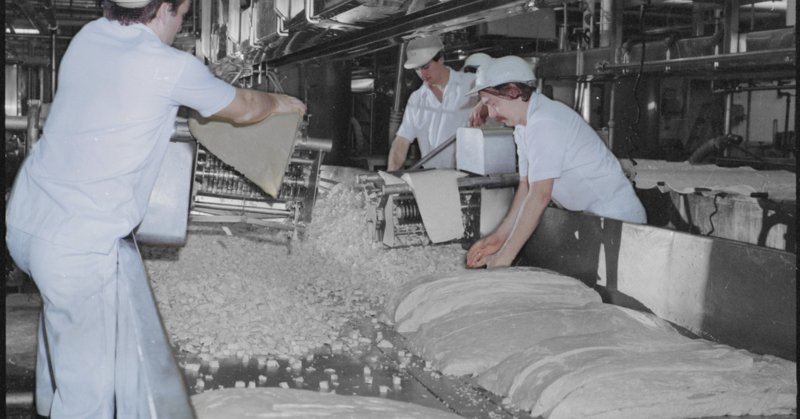
1. The earliest suggested dates for cheesemaking go back to about 8000 B.C., when sheep were first domesticated. Because milk could be kept in animal skins and inflated internal organs, it is likely that cheese was discovered by chance when milk was stored in an animal stomach container and the stomach rennet caused it to separate into curd and whey.
2. The earliest recorded use of toilet paper in human history dates to the 6th century A.D. in early medieval China. In 589 A.D., the scholar-official Yan Zhitui wrote about using toilet paper. An Arab traveler who visited China in 851 A.D. noted: “…they [the Chinese] do not wash themselves with water when they have done their necessities, but they only wipe themselves with paper.”
3. Although latex condoms and birth control pills are modern contraceptives, people have practiced birth control for a very long time. The Greeks used Silphium, a plant believed to have contraceptive and abortifacient effects. So much of it was wanted that Silphium became extinct by the third or fourth centuries. The Egyptian Ebers Papyrus from 1550 BC and the Kahun Papyrus from 1850 BC contain some of the earliest known descriptions of birth control: using honey, acacia leaves, and lint in the vagina to stop sperm.
4. The first vending machine was created 2,000 years ago in 1st century Roman Egypt, and it dispensed Holy Water. When a coin was inserted, it dropped onto a pan connected to a lever that allowed some water to flow out. A counterweight lifted the lever back up and shut off the valve after the coin tipped off the pan. Coin-operated machines that sold tobacco were already in use by 1615 in English taverns.
5. The check is older than cash. Ancient Romans are thought to have used an early check called praescriptiones in the 1st century B.C. Credit came before the check, and in fact before writing. Historians say the idea of using an instrument with no intrinsic value to stand in for banking transactions goes back 5,000 years, when ancient Mesopotamians used clay tablets to trade with the Harappan civilization. Although still unwieldy, a clay slab bearing seals from both civilizations was certainly preferable to the tons of copper each side would have needed to melt down to make the coins of that time.
6. Platforms such as Steam and Xbox Marketplace have altered how games are delivered to and used by gamers. They have made it simpler for consumers to play games without exchanging or buying new physical media. The earliest example of digital video game distribution appeared in 1981 with Gameline, a service that let Atari 2600 owners use a special cartridge to connect by phone line to a central server and rent a video game for 5 to 10 days. Computers in the 1980s could also save and load games to and from cassette tapes in a tape recorder. This essentially worked by treating the audio data as game data. This led some pirate FM radio stations in the 1980s to broadcast games directly over FM radio every weekend.
7. The earliest submersible for which reliable construction information exists was designed and built by a Dutchman named Cornelis Drebbel in 1620. It had oars that projected through leather seals and snorkel hoses for air. The first military submarine was the Turtle, built in 1775. It was a hand-powered, acorn-shaped craft made to hold one person. The Turtle was used in the American Revolutionary War.
8. Wealthy ancient Romans had central heating in their homes. They used a system known as hypocaust that generated and moved hot air beneath the floor of a room, and also heated the walls with a set of pipes through which the hot air flowed. The earliest example of this type of system was the temple of Ephesus, built in 350 B.C. Excavations at Mohenjo-Daro in what is now Pakistan have uncovered what is thought to be a hypocaust lined with bitumen-coated bricks. If it served a similar purpose, the structure would be up to 2000 years older than the earliest Roman hypocaust.
9. In the 1st century A.D., the Greek mathematician Heron of Alexandria invented the first known automatic door. He described two separate automatic door uses. The first was for opening temple doors. The mechanism used heat from a fire lit by the city temple priest. After a few hours, pressure from the atmosphere built up in a brass vessel and caused it to pump water into nearby containers. These containers served as weights that, through a set of ropes and pulleys, would open the temple doors around the time people were expected to arrive for prayer. Heron used a similar mechanism to open the city gates.
10. Nintendo is best known today as a video game company. Although video games have been one of its most successful business ventures, the company existed long before computers were invented, as a toy company. It was founded in 1889 when it made playing cards, which it still makes today.
Ancient Roots of Insult

11. In ancient times, the middle finger was used as a sign of sexual intercourse in a way intended to humiliate, frighten, and threaten the person on the receiving end. The Romans used the middle finger toward one another. The first recorded person to use it as an insult was the Greek philosopher Diogenes, who did so to Demosthenes in the 4th century B.C. after becoming weary of the argument.
12. The pipe organ is among the oldest instruments still played in European classical music and is commonly said to have come from Greece. Its earliest forerunners were created in Ancient Greece during the 3rd century B.C. The invention of this organ is credited to the Greek engineer Ctesibius of Alexandria.
13. Ancient Romans created concrete from limestone, water, and volcanic ash. This blend, along with the way it was cured, made a stronger and more eco-friendly concrete than modern Portland cement. By 25 B.C., Romans had also developed a concrete formula meant specifically for underwater use, which is essentially the same as the one used today. After the Roman Empire collapsed, the knowledge for making concrete disappeared for almost 1,000 years before being rediscovered in the 14th century.
14. The oldest known versions of bowling go back to ancient Egypt. As early as 3200 B.C., balls made from grain husks and tied together with leather and string were rolled across the ground in a game similar to modern target bowling. A similar game was popular in the Roman Empire around 2000 years ago, and it later developed into Italian Bocce, or outdoor bowling. Around 400 A.D., bowling started in Germany as a religious practice meant to wash away sin by rolling a rock into a club, or kegel.
15. Many people may assume that real smartphones first appeared in the late 2000s when Steve Jobs unveiled the iPhone in 2007. In fact, the first true smartphone was IBM’s Simon Personal Communicator, which debuted in 1992. It included features like a touchscreen and the ability to send and receive emails.
16. The Knights Templar invented the checking account in the 12th century. Crusaders would leave their valuables with the Knights before traveling to the Holy Land, then receive a certificate that allowed them to collect items of equal value when they arrived. This clever system was an early banking method and may have been the first official arrangement to enable the use of checks.
17. Aircraft autopilots may seem like a modern convenience for pilots, but they are nearly as old as airplanes themselves. In aviation’s early years, aircraft had to be watched constantly by a pilot to fly safely. Sperry Corporation created the first aircraft autopilot in 1912, only 9 years after the Wright Brothers made the first powered flight in 1903. This autopilot linked a gyroscopic heading indicator and attitude indicator to hydraulically operated elevators and rudder.
18. The oldest known written mention of ivory billiard balls appears in the 1588 inventory of the Duke of Norfolk. By the middle of the 19th century, elephants were being killed for their ivory at a troubling rate simply to satisfy demand for luxury billiard balls.
19. In the 5th century B.C., ancient Greeks in the markets of Athens ate snow combined with honey and fruit. In 400 B.C., the Persians created a special chilled dessert made of rose water and vermicelli that was served to royalty in summer. The ice was blended with saffron, fruits, and other flavors. Around 200 B.C. in China, a frozen mixture of milk and rice was used. They also poured a blend of snow and saltpeter over the outside of containers filled with syrup, since, just as salt increases water’s boiling point, it lowers the freezing point to below zero.
20. Tesla changed the way customers see the electric car, making it appear stylish, comfortable, and a mix of traditional automotive elements and futuristic features. Even so, electric cars are over a hundred years old. In 1884, more than 20 years before the Ford Model T, the first practical mass-produced electric car was built in London and used specially designed rechargeable batteries with high capacity.
Early Phone Music Machine
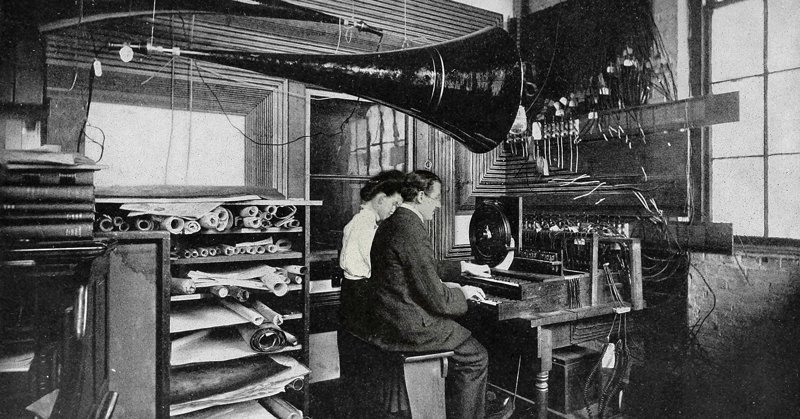
21. Music streaming was invented in 1897 in New York. It was called the Telharmonium and filled the entire basement of the Broadway building where it was housed. It was 220 feet long and used differently sized, cogged gears spinning beneath a pickup, or magnetic coil, to produce various tones. These different gears and pickups were linked to an organ on the building’s main floor. Pressing keys triggered the matching tone from the Telharmonium, and it also had pedals and similar controls to shape the sound. It sent this music over the telephone, and subscribers could have the operator connect them.
22. The history of marshmallows goes back as early as 2000 B.C. Ancient Egyptians were said to be the first to make them, and eating them was a privilege strictly reserved for gods and royalty, who used the root of mallow plant species to relieve coughs and sore throats and to heal wounds. The first marshmallows were made by boiling pieces of root pulp with honey until the mixture became thick. After thickening, the mixture was strained, cooled, and then used as intended.
23. The headphone jack we use today was invented in the 19th century. The larger version of the phone connector was invented for use in telephone switchboards in 1878. Its design has stayed the same except for its size. The original 1/4″ design is still standard on many audio equipments.
24. The first can openers appeared in 1855 and had a primitive claw-shaped design. This came about 83 years after the tin can was first used. Food preserved in tin cans had been used by the Dutch Navy since at least 1772. So for nearly a century, the cans weighed more than the food inside them and needed ingenuity to open, using whatever tools were available.
25. Foods similar to pizza have been made since the Neolithic age (10,200 to 4500 B.C.). If pizza means flat, baked bread, then pizzas are as old as the ancient Babylonians. If pizza means flat, baked bread with toppings, then they were invented in ancient Greece.


Add Comment