

Sudden Ice Age Chill
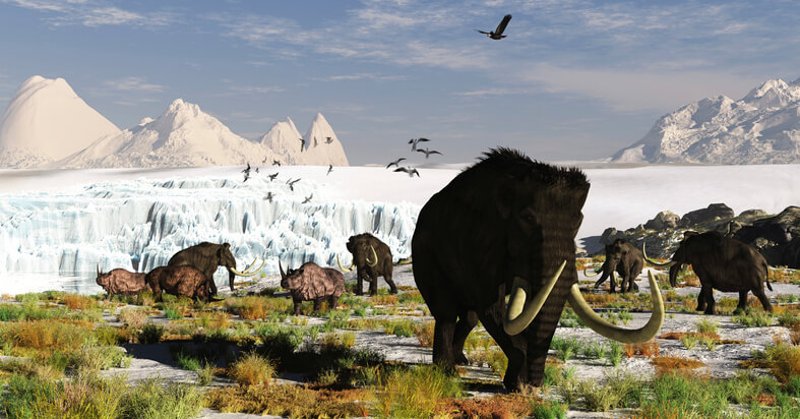
26. The Younger Dryas was a period about 12,000 years ago when Earth’s temperature fell by 2 to 6 degrees Celsius over just decades, an extremely rapid change in geological terms. It is debated whether asteroid impacts and volcanic eruptions caused it. Humans evolved light skin as a tradeoff between producing vitamin D and blocking UV, probably in response to the later Big Freeze.
27. Woolly mammoths were still alive when the pyramids of Giza were finished. The last woolly mammoths went extinct on Wrangel Island in Northern Russia 4,000 years ago. In an interesting twist, French explorers found so many preserved mammoth carcasses on an expedition to the North Pole that they were, for a time, a dependable food supply.
28. Scientists have identified Earth’s lost eighth continent. Plate tectonics split this continent, which was the size of Greenland, from North Africa more than 200 million years ago. Most of it lay beneath the water and created shallow tropical seas where sediment accumulated, including in large coral reefs. Unknowingly, many tourists vacation on this lost continent every year, which is now buried under Southern Europe and has been called Greater Adria.
29. The mammoth steppe was the largest biome on Earth. It stretched from Spain east across Eurasia to Canada and from the Arctic islands south to China. It lasted for about 100,000 years without major change and then abruptly became nearly extinct around 12,000 years ago. Its vegetation was mainly high-yield grasses, herbs, and willow shrubs, and its animal biomass was dominated by bison, horses, and woolly mammoths.
30. Earth’s magnetic poles do move. Around 780,000 years ago, the planet’s magnetic poles reversed, and another reversal may already be starting. The magnetic North Pole can travel in loops of up to 50 miles per day. It is gradually drifting west, and over the past 150 years it has moved a total of about 685 miles.
31. Four hundred million years ago, a day lasted 22 hours and a year contained more than 400 days, and 900 million years ago, a day lasted 18 hours. In addition, about every 13,000 years, winter falls in July in the northern hemisphere, with the opposite season shift in the southern hemisphere, because of Earth’s axial wobble.
32. There is a phase in Earth’s development in which activity slowed, a period scientists called the boring billion. Starting about 1.7 billion years ago, Earth turned into a slimy, almost motionless world of algae and microbes.
33. When the age of the dinosaurs ended about 65 million years ago, a tribe of ants called the Attini chose to stop living as hunter-gatherers and instead became farmers. Native to South America, these ants started cultivating fungus growing on decaying wood. This let ant colonies grow larger until 15 million years ago. Humans did not develop agriculture until 10,000 years ago.
34. About 2.5 billion years ago, the Oxygen Catastrophe took place, when the first microbes to make oxygen through photosynthesis produced so much free oxygen that it destroyed most life on the planet because those organisms were adapted to very low-oxygen conditions.
35. Most of Earth’s gold and other heavy metals are stored in the Earth’s core. Tungsten isotope evidence shows that most gold in the crust comes from gold in the mantle, and that mantle gold came from a meteorite bombardment around 3.9 billion years ago.
Burst Theory For Extinction
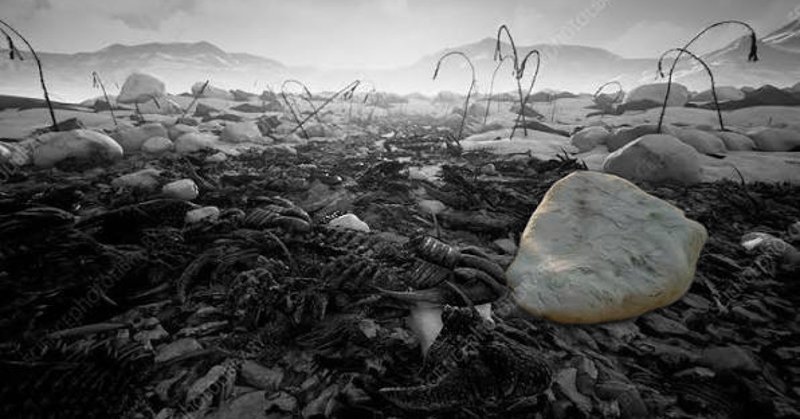
36. A leading explanation for the Ordovician-Silurian mass extinction is that a gamma-ray burst hit Earth 450 million years ago and destroyed nearly all life on the planet. Scientists suggest the burst may have come from a hypernova within 6,000 light-years of Earth. A 10-second burst would have rapidly removed half of the Earth’s ozone, exposing all life on Earth to very high levels of extreme ultraviolet radiation. About 85% of marine species were eliminated.
37. The oldest grasses did not appear until 60 to 55 million years ago, near the end of the major extinction events that brought the age of dinosaurs and the Cretaceous period to a close. For that reason, dinosaurs most likely ate leaves rather than grass because common grass had not yet evolved.
38. Salt does enter the ocean and form there, but it also leaves. Ocean salinity has remained steady for billions of years. The two main processes that can remove large amounts of salt from the ocean are evaporite formation, meaning rocks that form when confined salty water evaporates, and the storage of brine as groundwater on continents. It has even been suggested that the early ocean was saltier than it is today, perhaps as much as twice as salty. Over geologic time, salt was taken out of the oceans as Earth cooled and the continents expanded, creating more space that favored salt and evaporite deposition and the creation of saline groundwater. It has been argued that present-day salinity was not reached until fairly recently, possibly helping trigger the origin and spread of animal life, called the Cambrian Explosion.
39. Some scientists have suggested that Earth became completely frozen around 650 million years ago. Supporters of the Snowball Earth hypothesis say it best accounts for a billion missing years in Earth’s rock record. They contend that miles of ice wore away those rock layers and carried the sediment into the oceans, where it was then subducted into the mantle to be recycled. There are also very few fossil layers from before this time.
40. If the asteroid that killed the dinosaurs 66 million years ago had arrived just 30 seconds later, it would have struck deep ocean water, which would have absorbed much of the impact force. The resulting extinction would have been less severe, many dinosaur species would have survived, and humans would not exist today.


Add Comment