

Nature is full of creatures that seem more like science fiction than reality. From bizarre sea slugs and transparent butterflies to mammals that glide and birds that mimic chainsaws, these animals prove that evolution can produce some truly unbelievable designs.
Vivid Blue Warning To Predators
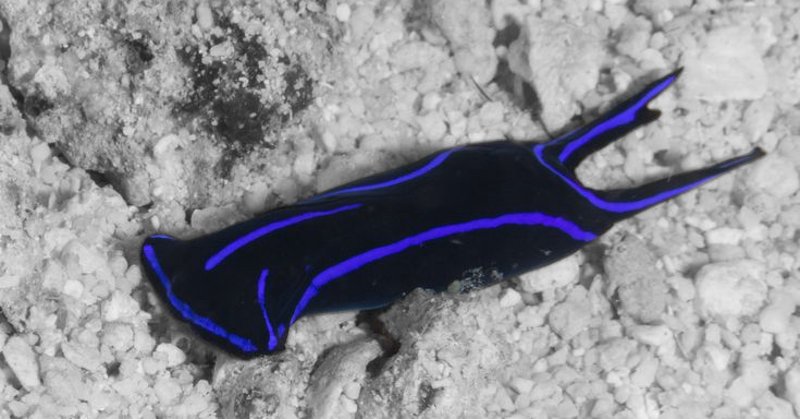
1. The Blue Velvet Nudibranch is a species of sea slug that shows its bright blue coloring to warn predators that it is toxic.
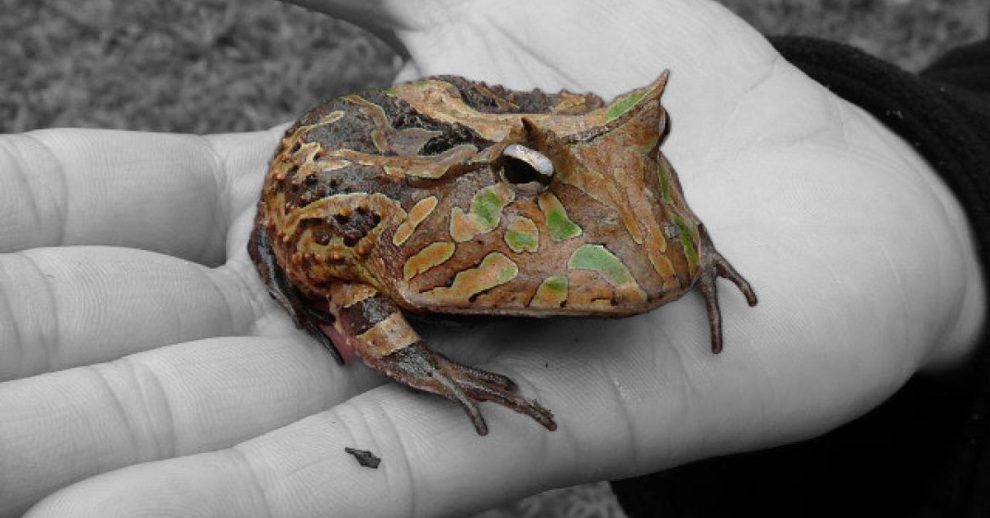
2. The Amazon Horned Frog, commonly known as the Pac-Man Frog, has a large mouth that can swallow prey almost as big as itself and attracts prey with its brightly colored mouth.
3. Along the Pacific coasts of North and South America, the Blue-footed Booby gets its name from its striking blue feet. Males display those feet during mating dances. Females lay several eggs a few days apart, and older siblings often push younger ones out of the nest.
4. The Blue Parrotfish can create a mucus cocoon at night that it uses for protection while sleeping, reducing its scent and visibility to predators.
5. The Japanese Spider Crab has the longest leg span among all arthropods, reaching up to 12 feet. Despite its intimidating appearance, it is a gentle creature that mainly feeds on debris. Its lifespan can reach 100 years, but it is at risk because it is sought after as a delicacy, making it close to being endangered.
6. First discovered in 2009, the Venezuelan Poodle Moth is an odd yet charming insect cloaked in white, fuzzy fur. Its precise classification remains disputed, and its appearance was so bizarre that when photographs first appeared online people doubted they were genuine.
7. Native to the Galapagos, the red-lipped batfish (Ogcocephalus darwini) has conspicuous red lips and uses its fins to walk along the ocean floor. A central illicium on its head looks similar to a human nose. It typically lives for about 12 years.
8. The Sunda Colugo, commonly called the flying lemur, glides through the air using a skin membrane stretched between its limbs. Although it is found across Southeast Asia, it is not a true lemur. It can glide more than 100 m while losing very little altitude.
9. The Surinam toad carries its eggs in an unusual manner: the female embeds them into pockets on her back, where they develop into fully formed toadlets that eventually break out of her skin.
10. The Shoebill of East Africa has a huge, shoe-shaped bill which it uses to catch fish and other prey. Often called a “living fossil” because of its prehistoric look, the shoebill hunts with deliberate slowness and great stillness. It is known for remarkable patience and stillness while hunting, and will even prey on young crocodiles.
Australia’s Sonic Mimicry Star
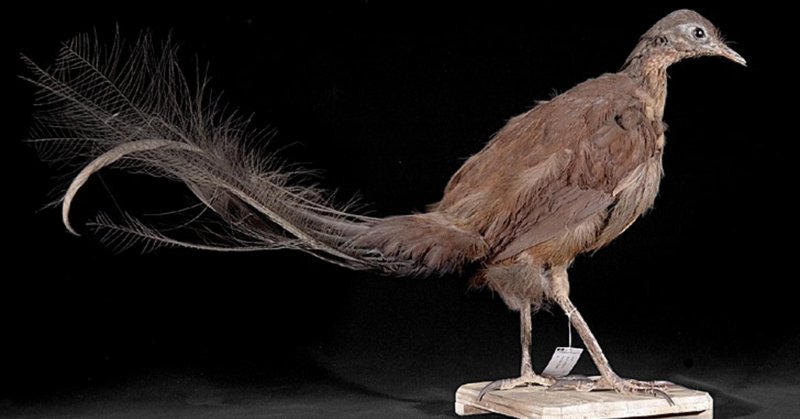
11. Native to Australia, the lyrebird is an exceptional mimic that can copy a wide range of sounds, including chainsaws, camera shutters, and other bird species. In the 1930s a flute player released his pet lyrebird into the wild, and the bird was able to reproduce certain phrases from the man’s music. Those tunes were shared with other lyrebirds, and the same melodies are still sung by these birds today.
12. The hoatzin, native to South America and often called the “Stinkbird,” has a strong odor caused by bacteria in its digestive system. It is the last surviving species of a bird lineage that split 64 million years ago after the dinosaur extinction event. Interestingly, hoatzin chicks have claws on their wings.
13. The axolotl, also known as the Mexican walking fish, is a salamander that remains aquatic for its entire life. Its remarkable regenerative abilities allow it to regrow lost limbs within weeks, as well as portions of its spinal cord, its heart, and even parts of its brain. Remarkably, it can stay in its larval form for its whole lifespan.
14. The Patagonian mara resembles a mix between a rabbit and a deer; it is a social herbivore that communicates using a variety of vocalizations.
15. The kakapo, a flightless parrot from New Zealand, is both the heaviest parrot species and one of the rarest, with only a few dozen individuals remaining. Growing up without threats, it lacks defensive strategies. If attacked, it may remain still or jump from a high branch, even though it cannot fly.
16. Native to Argentina, the Pink Fairy Armadillo is the smallest armadillo species in the world. It has a pale pink shell, uses its large front claws to dig burrows, and can even swim through sand.
17. The Chinese Water Deer is a small deer that does not have antlers but has long canine teeth used for display and defense. Most of these deer live in South Korea. Although they are endangered globally, South Korea permits hunting of water deer during certain seasons.
18. The Hagfish, which resembles a slimy eel, produces copious slime as a defense. When attacked it can quickly generate enough slime to clog a predator’s gills. Its slime can expand up to 10,000 times in an instant and is softer than Jell-O. Hagfish can also feed by inserting themselves into a corpse and absorbing nutrients directly through their skin and gills; their skin is actually more efficient at nutrient absorption than their intestines.
19. Living in deep waters, the Frilled Shark has fringed gills, which is how it got its name. Because of its primitive appearance it is often called a living fossil. It has the longest gestation period of any vertebrate, reaching up to three and a half years. It is rarely seen because it lives near the ocean floor and only comes near the surface before dying; that lifestyle has kept the species largely unchanged for thousands of years.
20. The Fossa, native to Madagascar, resembles a cross between a cat and a mongoose. It is the island’s top predator and is known for its speed and hunting skill. In young female fossas the clitoris enlarges and develops spikes so it resembles an adult male fossa’s penis. This adaptation helps protect them from older males.
Floating Blue Sea Predator
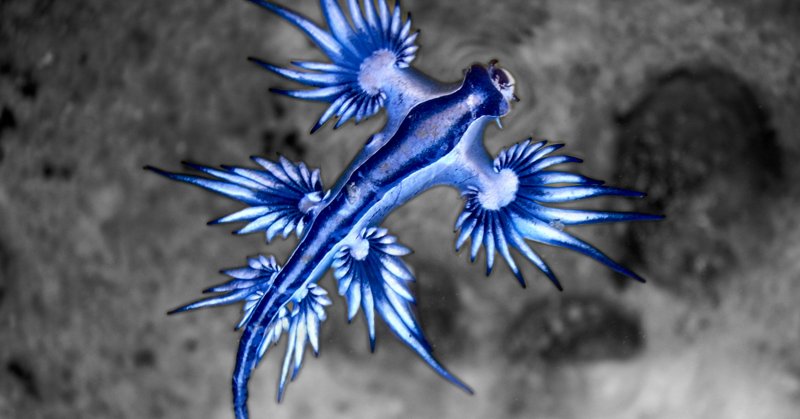
21. The “Blue Dragon,” scientifically known as Glaucus Atlanticus, is a sea slug with vivid blue coloring that can float on the surface tension of water. It preys on Portuguese man-of-wars, storing and using their poison.
22. The Satanic Leaf-Tailed Gecko from Madagascar looks like a dead leaf, complete with irregular edges and apparent bite marks. Its distress call, which resembles a child’s scream, contributes to its name.
23. The Pink Katydid is a rare genetic variation of katydid that displays bright pink coloration instead of the usual green or brown, causing it to be conspicuous in its natural surroundings.
24. The Blanket Octopus defends itself by unfurling a large, web-like membrane to appear larger and deter predators. Female blanket octopuses can grow up to two meters while males reach only about 2.4 cm, producing extreme sexual dimorphism. This misled scientists, so the first male Blanket octopus was not discovered until 2002 because they were looking for the wrong size.
25. The Glasswing Butterfly, native to Central and South America, has transparent wings that make it nearly invisible while fluttering. In Spanish-speaking regions it is also called “espejitos,” meaning “little mirrors.”






Add Comment