


Germany is far more than castles, cars, and beer festivals. Today we will explore the country’s surprising history, cultural quirks, scientific achievements, and everyday traditions that most people never hear about. From medieval legends to modern innovations, these facts reveal how Germany became one of the world’s most influential nations.
Bank employee

1. In 2013, a German bank employee fell asleep on his keyboard pressing the number ‘2’ key, which led to an unintended transfer of 222,222,222 euros instead of the intended 62 euros. A colleague was later dismissed for failing to catch the mistake.
2. During the Second World War, the USA dispatched former major league baseball catcher and OSS operative Moe Berg to attend a lecture by Dr. Heisenberg. Berg carried a pistol and was ordered to kill Heisenberg if the talk suggested Germany was near completing an atomic bomb.
3. German Chocolate Cake takes its name from its inventor, Sam German, and actually has no connection to the country of Germany.
4. The Pennsylvania Dutch are not Dutch by origin; they are German. When they arrived, they said “Deutsch,” which means German in their language. Since Germany is called “Deutschland” in their tongue, English speakers mistakenly thought they were saying “Dutch.”
5. In 1994, a U.S. soldier named Sgt. Stephen Schap in Germany beheaded his friend and took the severed head (Gregory Glover) to his wife in the hospital, who was expecting the deceased man’s child.
6. In Berlin, there is a construction initiative called House of One aiming to combine a Christian church, a mosque, and a synagogue within a single building.
7. Because Costa Rica was not part of the Treaty of Versailles, it has technically remained at war with Germany since World War I.
8. During the 1930s, Hollywood permitted the German government to censor movies in the United States and internationally if they portrayed Germany or the Nazis negatively.
9. In the 1960s, Germany chose to retroactively provide pensions to African soldiers from the imperial colonial army. Those applying were given a broom and instructed in German to perform the manual of arms, with all passing the test.
10. Hamburg, Germany, forbade K-Cups after classifying them as harmful to the environment.
Cornelius Gurlitt

11. In 2010, Cornelius Gurlitt, an elderly man in Germany, was examined for possessing large amounts of cash despite being unemployed with no clear income source. In September 2011, prosecutors secured a warrant to search his small apartment in Schwabing, Munich. By late February 2012, during the search, over a thousand artworks were found, valued at up to €50 million today. These pieces were believed to have been stolen by the Nazis around World War II.
12. Before World War II, the Czechoslovakian car manufacturer Tatra sued Volkswagen because the original Beetle closely resembled the Tatra T97. When Germany occupied Czechoslovakia in 1938, the Nazi regime dismissed the lawsuit.
13. Germany boasts one of the world’s most advanced waste management systems, recycling nearly 70 percent of waste, while most of the rest is clearly burned to produce energy.
14. East Germany developed its own cola brand. After the Berlin Wall fell and Coke and Pepsi entered the East, Vita-Cola’s sales almost vanished. It remains the top-selling cola in Thuringia, making this German state one of the rare regions where Coca-Cola is not the market leader.
15. In the United States, annual spending on pets exceeds the total amount Germany allocates to its entire defense budget.
16. A man named Timothy Ray Brown was cured of HIV in Germany through a bone marrow transplant from a donor who carried a genetic mutation that provides immunity to HIV. This mutation is fairly common in Northern Europe. Scientists believe this gene may have developed through natural selection during epidemics like smallpox or the Black Death.
17. To counter long-range rockets launched by Nazi Germany, British double agents deceived the Nazis into believing their missiles were falling short. As a result, in much of 1944, the Nazis struck locations miles beyond their intended targets.
18. Gyromitra esculenta is a mushroom resembling a brain and is so hazardous to consume that its sale is banned in Switzerland and Germany, although some consider it a delicacy.
19. Through NATO nuclear weapons sharing, the United States has supplied nuclear arms for deployment and storage by Belgium, Germany, Italy, the Netherlands, and Turkey. All U.S. nuclear weapons are secured with Permissive Action Links, preventing host countries from arming them without authorization codes from the United States Air Force.
20. In 2005, a German TV show pilot named Sperm Race featured twelve men donating sperm to a Cologne lab, where three doctors monitored the sperm as they ‘raced’ toward an egg with some chemical stimulation. The contestant with the fastest sperm was to win a new red Porsche, but the program never aired.
Bridge over the High Rhine
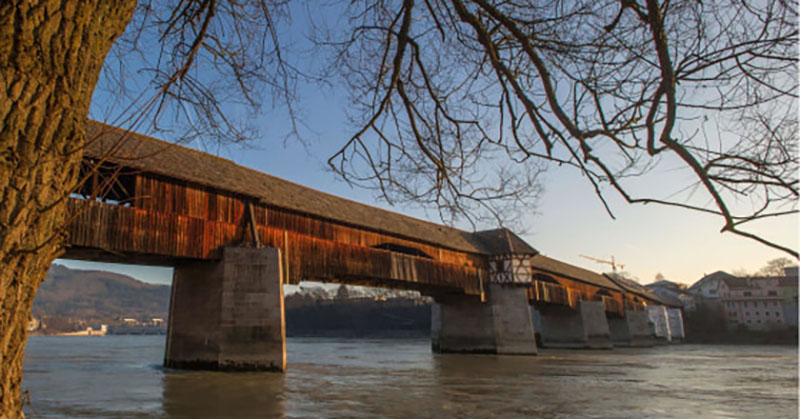
21. When engineers built a bridge (High Rhine Bridge) connecting Germany and Switzerland, they discovered that the elevations of the two sides differed by 54 cm when joined. Germany uses the North Sea as the reference for sea level, while Switzerland uses the Mediterranean; an error occurred in the correction process, doubling it instead of negating it.
22. Located in the Catherine Palace of Tsarskoye Selo near Saint Petersburg, the Amber Room is a fully decorated chamber featuring amber panels backed by gold leaf and mirrors. Constructed in the 18th century, it vanished during World War II and was reconstructed in 2003. Prior to its disappearance, the Amber Room was occasionally called the “Eighth Wonder of the World” because of its unique beauty. It spanned over 55 square meters and held more than six tons of amber. The Amber Room was stolen by Nazi Germany during World War II, and information about its location was lost amidst the war’s end chaos.
23. Hosting the 2006 World Cup led to a baby boom in Germany. Nine months following the football event, the birthrate in Germany rose by as much as 30% compared to the same period in the previous year.
24. From 1939 to 1945, between 73% and 100% of people with schizophrenia living in Germany were either sterilized or killed. Currently, Germany’s schizophrenia rates align with those of other developed countries.
25. In the 13th century, Frederick II, the German emperor, conducted an experiment to determine which language humans would naturally speak by placing 50 newborns with nurses who would only feed and bathe them, without speaking to or holding them. No answer was obtained because all the infants died.





Add Comment